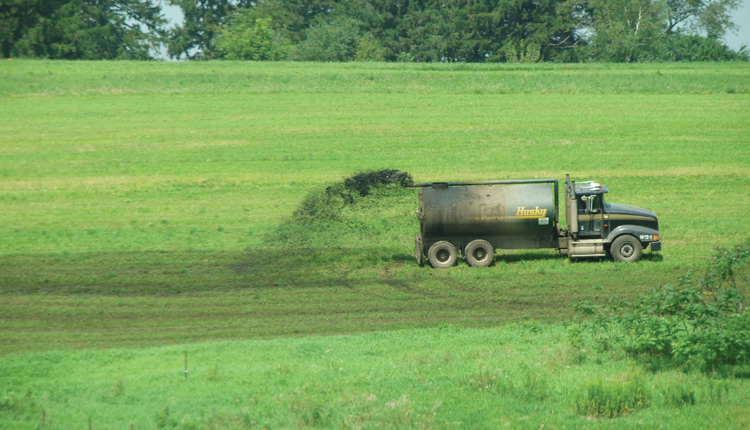
A new nutrient management strategy incorporating high-clearance robotic irrigation (HCRI) on row crops was highlighted in the last issue of this magazine. The technology has gained traction in the Midwest, especially in eastern Wisconsin. Dairy operations are utilizing this technology to apply nutrients in the summer when crops are growing — a spreading window that has been tough to hit. With the trade name 360 RAIN, HCRI allows farms to spoon-feed leachate or manure applications all summer long, providing nutrients and moisture to the root zone when crops need it most.
Spreading in the summer takes pressure off a farm to apply manure in the fall when conditions are typically more wet, cold, and unpredictable. As a bonus, these systems are great for irregularly shaped fields where center pivots cannot reach into corners and wedges.
Keep nutrients in the field
From a water quality standpoint, using 360 RAIN in the summer allows crops to uptake the added nutrients, compared to spreading manure in the fall when nutrients are more vulnerable to losses in frozen conditions. A dairy farmer in Calumet County, Wis., bought an HCRI with the goal to spoon-feed nutrients to his corn last summer. From the end of July into August, he spread 22,000 gallons per acre with three passes. Using leachate water and a little manure, this added a total of 5.42 pounds of phosphorus (12.32 pounds of P2O5 per acre) and 40.7 pounds of nitrogen per acre.
Applying manure during the season when the crop can utilize the water and nutrients provides higher efficiency than applications in fall or spring when a crop is not readily using nutrients or extra water. Next year, he hopes to start using 360 RAIN sooner in the season, which will add necessary nutrients to the growing corn at an earlier growth stage.

Finding real savings
This technology also shows promising cost-reduction potential. A dairy farmer in Kewaunee County, Wis., recorded his costs to compare his typical dragline setup versus the HCRI technology. The cost of applying manure using a traditional dragline, including his own equipment, diesel fuel, pumps, and so forth, came to $0.012 per gallon of manure pumped. A local manure hauler priced their cost around 2 cents per gallon of manure pumped. His 360 RAIN costs, including the price of the initial purchase of the machine spread over 10 years, electricity, and fuel, came to $0.006 per gallon. In both cases, using 360 RAIN costs less than half the price of spreading manure using a dragline.
This farmer also saved on fertilizer costs using this approach. One of his fields where he ran the 360 RAIN received 16,000 gallons per acre in the 2025 growing season, adding 89.6 pounds of nitrogen. He chose not to add any supplemental nitrogen on this 65-acre field, saving about $1,850 (at 50 cents per pound of nitrogen and 30 pounds of nitrogen per acre). His corn yield on this field was average for the farm.
One of the biggest benefits for this farmer was the pressure it took off his system to spread large amounts of manure in the fall. In the 2025 growing season, he was able to spread 3.5 million gallons of manure and 3.7 million gallons of leachate using the new technology.

Going the distance
One limitation about the 360 RAIN is that it needs to be used on fields close to the manure pit, where hoses can reach. However, a dairy farmer from Manitowoc County, Wis., also runs a manure hauling business and found a way to combat this issue. He put his 360 RAIN on his furthest field, 7.8 miles away (a 13-minute drive) and ran it there for three weeks. He had one tanker traveling every 30 minutes from manure pit to field, allowing the device to run for about 10 hours every day. This approach allowed the spread of 10,000 gallons per acre of manure, or 2 million total gallons.
A quick calculation of costs showed this use of the 360 RAIN was about the same price as traditional spreading, but the farmer stated, “A big benefit, which is hard to put a price tag on, is not having to haul those 2 million gallons in fall. Anything we can do in the summer on a growing crop helps reduce fall or spring hauling when the opportunity for loss is highest and when we have to fight the most unpredictable weather.”
The 2025 growing season was each of these farmers’ first year incorporating a 360 RAIN into their systems. They all gave positive feedback. These farmers plan to use the tool even more, like to water cover crops in the fall to get a boost on growth before winter. Or, they may purchase another unit so more manure can be spread during the growing season.
One lesson learned was to not spread straight manure using the tool, but to cut in leachate water. This helped minimize the odor on hot days. Another important note is to plan ahead in your nutrient management planning. Be sure you do not overapply nutrients by spreading manure the previous fall on a field where you plan to use the HCRI technology.
When it comes to manure, application timing is crucial for nutrients to be optimized. Spring and fall tend to have more unpredictable weather and can cause manure to be spread in conditions when nutrients can be lost through runoff.
The 360 RAIN system allows for leachate and manure spreading while a crop is growing to uptake the nutrients during warmer, drier months. Opening up the summer spreading window has the potential to improve water quality risks as well as take the pressure off spreading large amounts of manure in the nongrowing season.
The author is an agriculture water quality specialist with the University of Wisconsin-Madison Division of Extension.
This article appeared in the May 2026 issue of Journal of Nutrient Management on pages 6 and 7.
Not a subscriber? Click to get the print magazine.